15+ Years Experience6,000+ IVF Successes70%+ Success RateBook Your Consultation Today15+ Years Experience6,000+ IVF Successes70%+ Success RateBook Your Consultation Today
Infertility Causes & Condition — Understand the Cause Before You Choose a Treatment
If you have been trying to conceive without success, the hardest part is often not knowing why. The uncertainty is exhausting — and it is frequently made worse by well-meaning advice, conflicting internet searches, and the quiet assumption that someone must be “to blame.” None of that helps. What helps is an accurate understanding of what is actually happening.
Infertility is common — it affects roughly one in seven to one in ten couples — and in the large majority of cases it has a specific, identifiable cause. That cause may lie with the female partner, the male partner, both, or occasionally remain unexplained even after thorough testing. At Wellspring IVF & Women’s Hospital, Dr. Pranay Shah begins every couple’s journey the same way by finding the cause before recommending any treatment.
This page is your map of that landscape. It explains the major causes of infertility in women and men, when you should see a specialist, and how a diagnosis is actually made — then points you to the specific guide for your situation. Knowing the cause is the first step toward the right treatment, and you do not have to work it out alone.
Not conceiving after 12 months of regular, unprotected intercourse (6 months if the woman is 35 or older).
How common
Roughly 10–15% of couples experience infertility; it is common and, in most cases, treatable.
Female factors
Account for about 40% of cases — ovulation disorders (PCOS), tubal blockage, endometriosis, fibroids, low ovarian reserve, uterine factors.
Male factors
Involved in roughly 40–50% of cases — low count, poor motility, abnormal morphology, azoospermia, sperm DNA fragmentation.
Combined / unexplained
Both partners contribute in many couples; about 10–15% remain “unexplained” after a full workup.
The Wellspring Rule
Diagnose both partners first. The cause determines the treatment — not the other way round.
When to seek help
After 12 months of trying (6 months if 35+), or sooner with irregular cycles, known PCOS/endometriosis, prior pelvic surgery, or a known male-factor issue.
📞 9099946050│Mon–Sat, 10 AM – 4 PM│WhatsApp enquiries welcome
What Causes Infertility? — Female, Male, Combined & Unexplained
Infertility is defined as not conceiving after twelve months of regular, unprotected intercourse — or six months if the woman is 35 or older. It is not a single disease but a symptom with many possible causes. Crucially, those causes are split almost evenly between the two partners, which is why evaluating only one is a common and costly mistake.
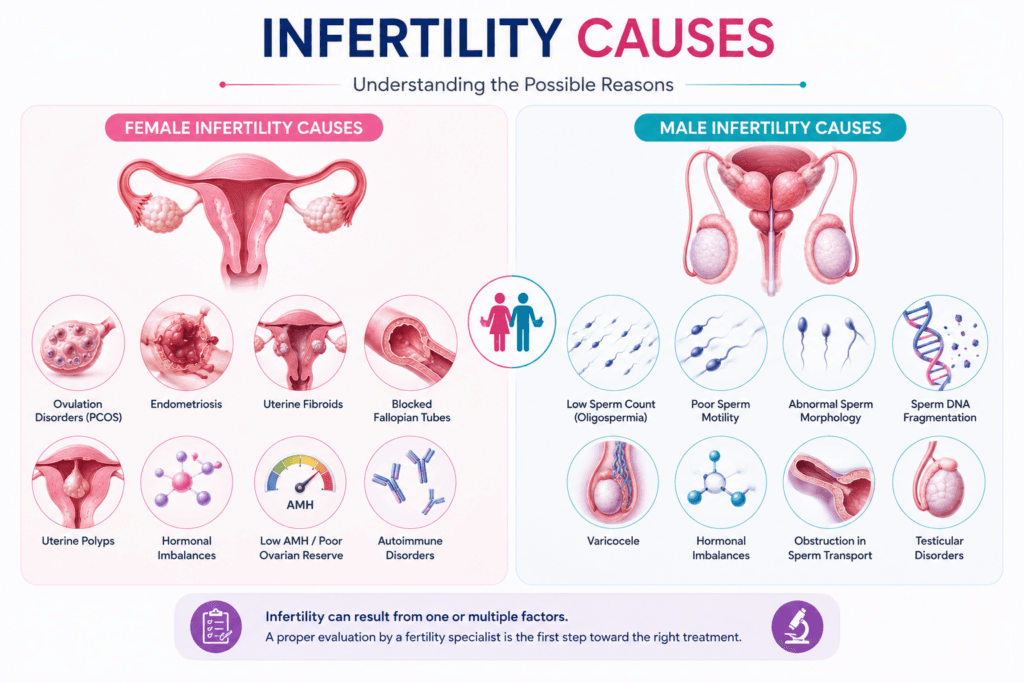
Broadly, the causes fall into four groups. Female factors account for around 40% of cases and include ovulation disorders (most commonly PCOS), blocked or damaged fallopian tubes, endometriosis, uterine abnormalities such as fibroids and polyps, and reduced ovarian reserve. Male factors are involved in roughly 40–50% of cases and include low sperm count, poor motility, abnormal morphology, complete absence of sperm (azoospermia), and high sperm DNA fragmentation. In a significant proportion of couples both partners contribute, and in about 10–15% the cause remains unexplained even after a complete workup — which does not mean untreatable.
The Most Important Fact on This Page
Infertility is not primarily “a woman’s problem.” A male factor is involved in roughly 40–50% of couples. This is why, at Wellspring, both partners are always evaluated from the start — a semen analysis for him is as routine and essential as ovarian-reserve testing for her. Diagnosing one partner and treating blindly is how months and money are wasted.
A contributing factor in both partners simultaneously
Evaluate both partners
Unexplained
~10–15%
All standard tests normal; cause not identified
Often still treatable with IVF/IUI
Infertility Is a Shared Diagnosis — The Numbers
When couples struggle to conceive, the instinct is to focus on the woman. Scans are arranged for her. Blood tests are ordered for her. Months pass. This is the single most common and most costly mistake in fertility medicine:
40%
Female Factor
Ovulation, tubal, uterine, or ovarian reserve cause identified in the woman
40-50%
Male Factor
Sperm count, motility, or DNA issue identified in the man
30%
Combined or Unexplained
Both partners have contributing factors, or no single cause found despite full investigation
What this means for you: There is a 65% chance that the male partner is the sole or contributing cause of your difficulty conceiving. A semen analysis costs a fraction of any female fertility investigation — and can be completed in under an hour. At Wellspring IVF, we investigate both partners from Day 1.
Choose Your Infertility condition guide
Infertility has a cause. Sometimes it is female. Sometimes it is male. Often it is both. Select the path most relevant to your situation — each section contains complete diagnostic and treatment information:
Female Infertility — Causes & Conditions
Difficulty conceiving, irregular periods, hormonal issues, previous diagnosis, or unexplained failure after IVF — start here.
The honest answer is: sooner than most couples think. The standard medical guidance is to seek evaluation after twelve months of regular, unprotected intercourse without conception — or after six months if the woman is 35 or older, because egg quantity and quality decline with age and time becomes the scarce resource. But waiting the full period is not always right.
See a fertility specialist earlier if any of the following applies: irregular or absent periods (a sign of ovulation problems such as PCOS); known or suspected endometriosis; previous pelvic surgery, pelvic infection, or ectopic pregnancy; a known male-factor issue or prior abnormal semen analysis; two or more miscarriages; or simply if you are over 35 and want to understand your reserve before more time passes. Early evaluation is not “jumping the gun” — it preserves options.
Why Time Matters More Than Most Couples Realise Of all the factors that influence fertility, age is the single most powerful — and the only one that cannot be reversed. A full evaluation does not commit you to any treatment; it simply tells you where you stand and what your options are while they are widest. For couples over 35, the cost of “waiting a bit longer” is measured in declining egg quality. Knowing early is always better than knowing late.
Situation
When to Consult a Fertility Specialist
Under 35, regular cycles, no known issues
After 12 months of unprotected regular intercourse without conception
35–37 years of age
After 6 months of trying — do not wait 12 months
Over 38 years of age
Start investigation immediately — even before trying for 3 months
Irregular or absent periods (PCOS, thyroid)
Seek evaluation before starting to try — do not delay
Known endometriosis, fibroids, or prior surgery
Consult before trying — pre-treatment may improve chances significantly
Known male factor (previous semen report)
Seek specialist evaluation immediately — time matters
2 or more pregnancy losses (any gestation)
Investigation after 2 losses — do not wait for a third
Any prior IVF failure
Seek a second opinion with full cycle review — do not repeat blindly
The Wellspring IVF Approach For Infertility Diagnosis — Both Partners, Day One
The single most important difference in Dr. Pranay Shah’s approach is the one that couples feel from their very first appointment: both partners are investigated at the same time.
This sounds obvious. In practice, it rarely happens. Across India, fertility workups are still initiated almost exclusively on the female partner. The male partner enters the picture — often only for a semen test — weeks or months into the process. By this time, the couple has already undergone scans, blood tests, and sometimes procedures, without knowing whether the primary factor is male.
At Wellspring IVF, the first consultation ends with investigation orders for both partners. The semen analysis result is available the same day. The female hormonal panel returns within 24–48 hours. By the second consultation, we have a complete picture — and a real plan.
What Happens at Your First Consultation at Wellspring IVF
Complete history for both partners: Duration of trying, previous pregnancies, prior treatments, surgical history, medications, lifestyle factors.
Semen analysis for the male partner: Produced privately at our andrology lab. Count, motility, morphology, volume. Report ready within the same appointment or same day.
Day 2–3 hormonal panel for the female partner: FSH, LH, AMH, Oestradiol, TSH, Prolactin. AMH gives us an immediate read on ovarian reserve.
Treatment plan presented: At the follow-up consultation with all results in hand, Dr. Shah presents a clear, personalised plan — with full explanation of what was found and why each step is recommended.
Couples come to us after years of investigation — with a folder full of female reports and a single semen test done as an afterthought six months in. In a third of those cases, the answer was in that semen test all along. Investigating both partners simultaneously is not a protocol. It is basic respect for the couple’s time.
— Dr. Pranay Shah, MS (ObGy), Director & Chief Fertility Consultant, Wellspring IVF & Women’s Hospital, Ahmedabad
Why Wellspring IVF for Infertility Evaluation? — The Diagnosis-First Difference
Both partners, always. A semen analysis for the male partner is as routine here as ovarian-reserve testing for the female partner. Because a male factor is involved in roughly half of couples, evaluating only one partner is a mistake Wellspring does not make.
The cause drives the treatment — not the reverse. Dr. Shah does not start from a treatment and work backward. He starts from your diagnosis and recommends the least-invasive option that gives a realistic chance — which is often simpler and less expensive than couples fear.
Mechanism explained, not just labels. You will not just be told you have “low AMH” or “PCOS.” You will be told what it means for you, what it does and does not rule out, and what the realistic path forward looks like.
One consultant through the whole journey. The same doctor who diagnoses you performs your procedures and reviews your results — continuity that matters in a journey this personal.
Honest expectations. Dr. Shah tells couples what their actual chances are — not what they want to hear. That honesty is the foundation of every treatment plan at Wellspring.
“The first question almost every couple asks me is ‘whose fault is it?’ — and it is the wrong question. Infertility is a shared medical condition with a cause we can usually identify, and a male factor is involved about as often as a female one. My job at the first consultation is to find that cause in both partners, explain it in plain language, and tell you honestly what it means. Once we know the cause, the right treatment is usually obvious — and it is far more often something straightforward than the worst-case scenario couples have imagined while waiting. Understanding is the first treatment.”
— Dr. Pranay Shah, MS (ObGy), Director & Chief Fertility Consultant, Wellspring IVF & Women’s Hospital, Ahmedabad
★★★★★ 5.0/5.0
What Our Patients Say
Real stories from real families who trusted us with their fertility journey
750+ Google Reviews • Verified Patient Testimonials
I visited many doctors before, but this doctor was the one who correctly identified my issue and provided the right treatment. I finally started seeing real results after consulting them. Very knowledgeable, attentive, and professional. Highly recommended.
Heartfelt thanks to the entire team of Wellspring Hospital. After feeling disappointed and losing hope at many places, coming here was the best decision. A special thank you to Dr. Pranay Shah for his confidence, guidance, and the way he explained everything so patiently. His positive approach gave me so much strength, and today I am blessed with my baby. Thank you to each and every member of the hospital for taking such great care of me and supporting me throughout this journey. Forever grateful. 💕
Some doctors treat symptoms. Rare ones treat the human being sitting in front of them.
He is, without a doubt, the most patient doctor I have ever met. Of course, treatment can be done by many. What truly sets him apart is his maturity, the way he pauses, explains, comforts, and most importantly, seeks your permission before moving forward. You never feel rushed. You never feel unheard. You feel respected.
And the staff deserves equal appreciation. They handle even the most anxious and impatient moments with such calm grace and dignity that you slowly find your own heartbeat settling down. It feels less like a clinic and more like a safe space.
I wholeheartedly recommend him to anyone who overthinks, seeks reassurance, or simply needs a doctor who believes comfort is the first step of healing. With him, care begins long before the treatment does.
Dr Shah is highly knowledgeable, through and dedicated. He explained every step of the process in simple terms, ensuring we were informed and comfortable. The entire team and staff are very kind and caring. Highly recommend for their expertise, kindness and dedication. "Turned out dream into reality"
We had a great experience with Wellspring. Dr Pranay Shah is a very good person and possess the good knowledge. His guidance and treatment helped us fulfill our wishes. The hospital staff is also very kind and supportive. I strongly recommend Wellspring.
I want to express my heartfelt gratitude to Dr. Pranay Shah and the team at Wellspring IVF & Women’s Hospital. This journey is never easy, but Dr. Shah made me feel comfortable, cared for, and fully supported throughout the IVF process. Thank you
Our hearts are overflowing with gratitude and joy as we reflect on our incredible journey to parenthood, made possible by the extraordinary care and expertise of your team. The IVF process was, at times, daunting and exhausting, but your unwavering support, compassion, and professionalism helped us remain hopeful through every step. From the very first consultation to the celebratory moment when we learned our treatment was successful, we felt respected, understood, and truly cared for.Thank you for believing in us, never giving up, and guiding us through every challenge with warmth, patience, and encouragement. Your personalized guidance, gentle approach, and positive outlook gave us strength, and your medical skill brought our dream to life. We are forever grateful for your remarkable ability to merge empathy and science, giving hope to couples like us. Our gratitude also extends to everyone in your clinic who offered a smile, reassurance, technical support, or a listening ear along the way. We feel incredibly blessed to have chosen your practice for our journey, and we will always cherish the precious gift you helped us receive. Thank you, from the bottom of our hearts, for making our dream a reality.
Join 750+ Satisfied Families
Read all our verified Google reviews or share your own experience
Approximately 10–15% of couples complete a full fertility workup and receive results within the normal range for both partners. This is classified as "unexplained infertility" — and it is one of the most frustrating diagnoses in medicine. However, "unexplained" does not mean "untreatable." It most commonly means that standard tests have not captured a subtle issue. Advanced investigations available at Wellspring IVF include:
Sperm DNA Fragmentation (DFI)
Normal semen analysis but high DNA damage — a common hidden cause of IVF failure.
Endometrial Receptivity Analysis (ERA)
Tests whether the uterine lining is receptive to embryo implantation at the precise time of transfer — a personalised implantation window test.
Hysteroscopy
Direct visual inspection of the uterine cavity. Subtle polyps, synechiae (adhesions), or endometritis (uterine infection) are not always visible on ultrasound.
Thrombophilia (clotting) panel
For recurrent implantation failure — certain clotting disorders impair blood flow to the developing embryo.
Preimplantation Genetic Testing (PGT-A)
Screens embryos for chromosomal abnormalities before transfer. Identifies embryos most likely to implant and least likely to miscarry.
Frequently Asked Questions
Find answers to common questions about IMSI, nuclear vacuoles, DFI, and how IMSI differs from standard ICSI.
How do we know whether the problem is with me or my husband?
You find out by testing both of you — simultaneously. At Wellspring IVF, the first consultation ends with investigation orders for both partners. The semen analysis is available the same day. The female hormonal panel within 24–48 hours. Within one week of your first appointment, Dr. Shah typically has enough information to identify the primary factor — whether it is female, male, or both.
We have been trying for 8 months. Is it too early to see a doctor?
If you are under 35, the standard guideline is 12 months before seeking help. However, there are important exceptions: if you have irregular periods, known PCOS, any prior pelvic surgery, or any history of infection — do not wait 12 months. And if you are over 35, 6 months is the threshold. There is no harm in consulting earlier — a good specialist will simply reassure you and monitor, not rush you into treatment.
All our tests are normal but we still cannot conceive. What is wrong?
This is ‘unexplained infertility’ — affecting approximately 10–15% of couples. Standard tests are genuinely normal. The next step is advanced investigation: sperm DNA fragmentation, ERA (endometrial receptivity), hysteroscopy, and a thrombophilia panel. In the majority of unexplained cases, one of these advanced tests reveals the answer.
Does a diagnosis mean I will need IVF?
Not necessarily. IVF is one treatment among several, and at Wellspring it is never the automatic first step. Depending on your diagnosis, the right treatment may be ovulation induction, a hysteroscopic correction, or IUI — IVF is recommended only when the clinical picture clearly supports it (for example, blocked tubes, severe male factor, or failed simpler treatments). Your diagnosis determines the treatment; for the full range of options, see our Fertility Treatments hub.
Is IVF the only treatment option for infertility?
No — and in many cases, it is not even the first option. IVF is indicated for specific diagnoses: blocked tubes, severe male factor, IUI failure, advanced age with time constraints, or complex combined factors. For many other diagnoses — mild PCOS, mild male factor, ovulation disorders, correctable uterine issues — treatment with medication, lifestyle change, or IUI is appropriate first. Dr. Shah’s approach is to use the minimum necessary intervention for each specific diagnosis.
Does age really matter that much for fertility?
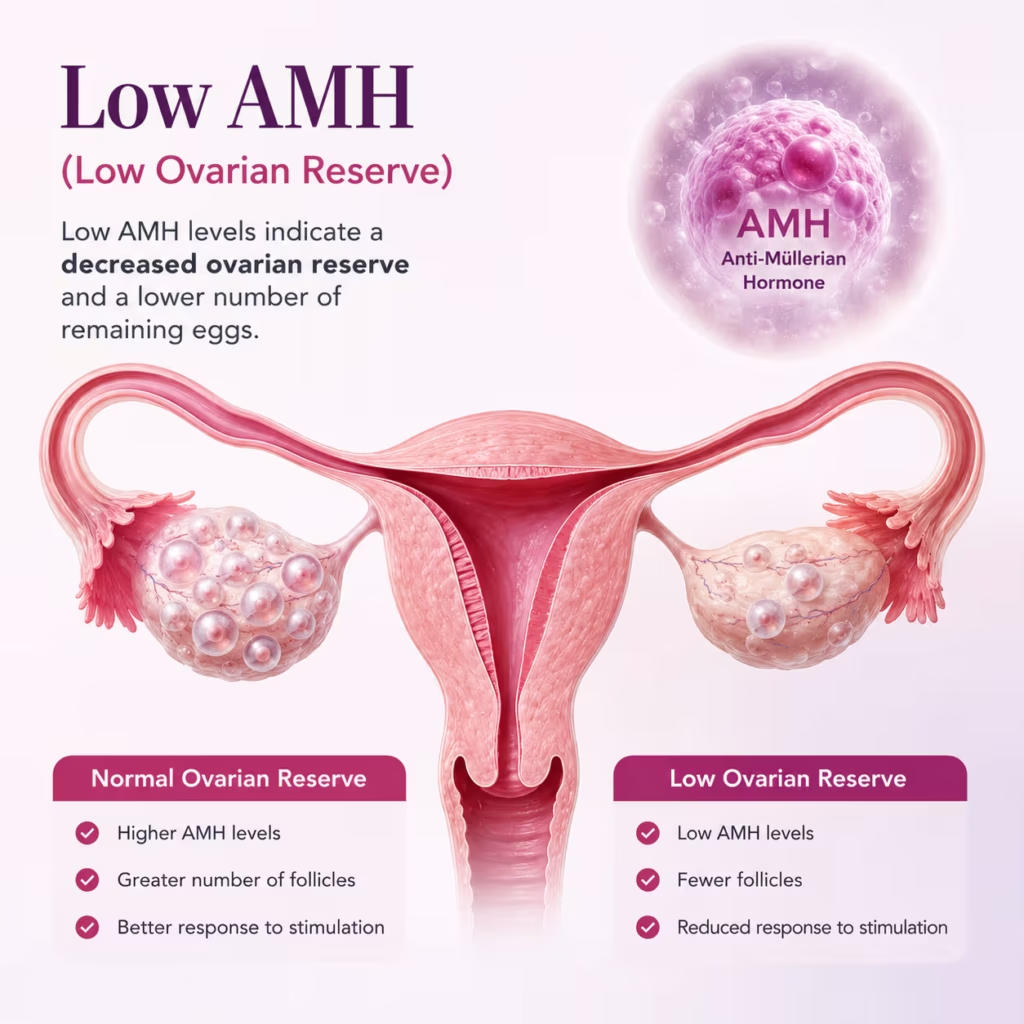
For female fertility — yes, significantly. A woman is born with her entire lifetime supply of eggs. Egg number (ovarian reserve) and egg quality both decline with age — the decline accelerates meaningfully after 35 and sharply after 38. For men, age also matters, but the decline is more gradual. This is why we recommend earlier consultation for women over 35, and why we always check AMH (Anti-Müllerian Hormone) at the first appointment — it gives an accurate, age-independent measure of ovarian reserve.
If my husband’s semen analysis comes back normal, does that completely rule out male factor infertility?
Not necessarily. A standard semen analysis checks the basic metrics: sperm count, motility (movement), and morphology (shape). However, it does not look inside the sperm’s genetic material. Many couples diagnosed with “unexplained infertility” actually have high Sperm DNA Fragmentation (DFI)—meaning the sperm looks perfectly healthy under a regular microscope, but carries microscopic DNA damage that prevents successful fertilization or causes early miscarriage. If you have normal routine reports but are still facing unexplained delays or recurrent IVF failures, Dr. Pranay Shah recommends advanced testing like Sperm DNA Fragmentation (DFI) to uncover these hidden factors.
Is infertility treatable?
.
In most cases, yes. The majority of infertility causes are identifiable and treatable, often with simpler measures than couples expect — ovulation medication, a minor corrective surgery, or IUI — with IVF reserved for cases that genuinely need it. Even “unexplained” infertility is frequently treatable. The first step is always an accurate diagnosis; once the cause is known, an effective treatment plan can almost always be made.
Can lifestyle or stress cause infertility?
Lifestyle factors can contribute to, but are rarely the sole cause of, infertility. Smoking, significant excess or very low body weight, excessive alcohol, and certain occupational exposures can reduce fertility in both partners, and these are worth addressing. Stress, while it does not by itself usually cause infertility, is a very real part of the experience and deserves support. A proper evaluation distinguishes a genuine medical cause from contributing factors — which is why self-diagnosing from internet searches is rarely accurate.
In most cases, infertility has a specific, identifiable cause.The investigation that finds it — for both partners — takes one week. Book a consultation with Dr. Pranay Shah and begin with answers, not assumptions.
 The Most Important Fact on This Page


 Why Time Matters More Than Most Couples Realise