15+ Years Experience 6,000+ IVF Successes 70%+ Success Rate Book Free Consultation Today 15+ Years Experience 6,000+ IVF Successes 70%+ Success Rate Book Free Consultation Today
ADVANCED TUBAL FERTILITY TREATMENT

Blocked Fallopian Tubes Treatment in Ahmedabad

Blocked fallopian tubes can prevent the egg and sperm from meeting, making natural conception difficult. At Wellspring IVF, we use advanced diagnostics and personalized treatment options to restore fertility and improve your chances of a successful pregnancy.
✓ Medically reviewed by Dr. Pranay Shah, MS (ObGy)

Blocked Fallopian Tubes Treatment in Ahmedabad — Surgery or IVF?

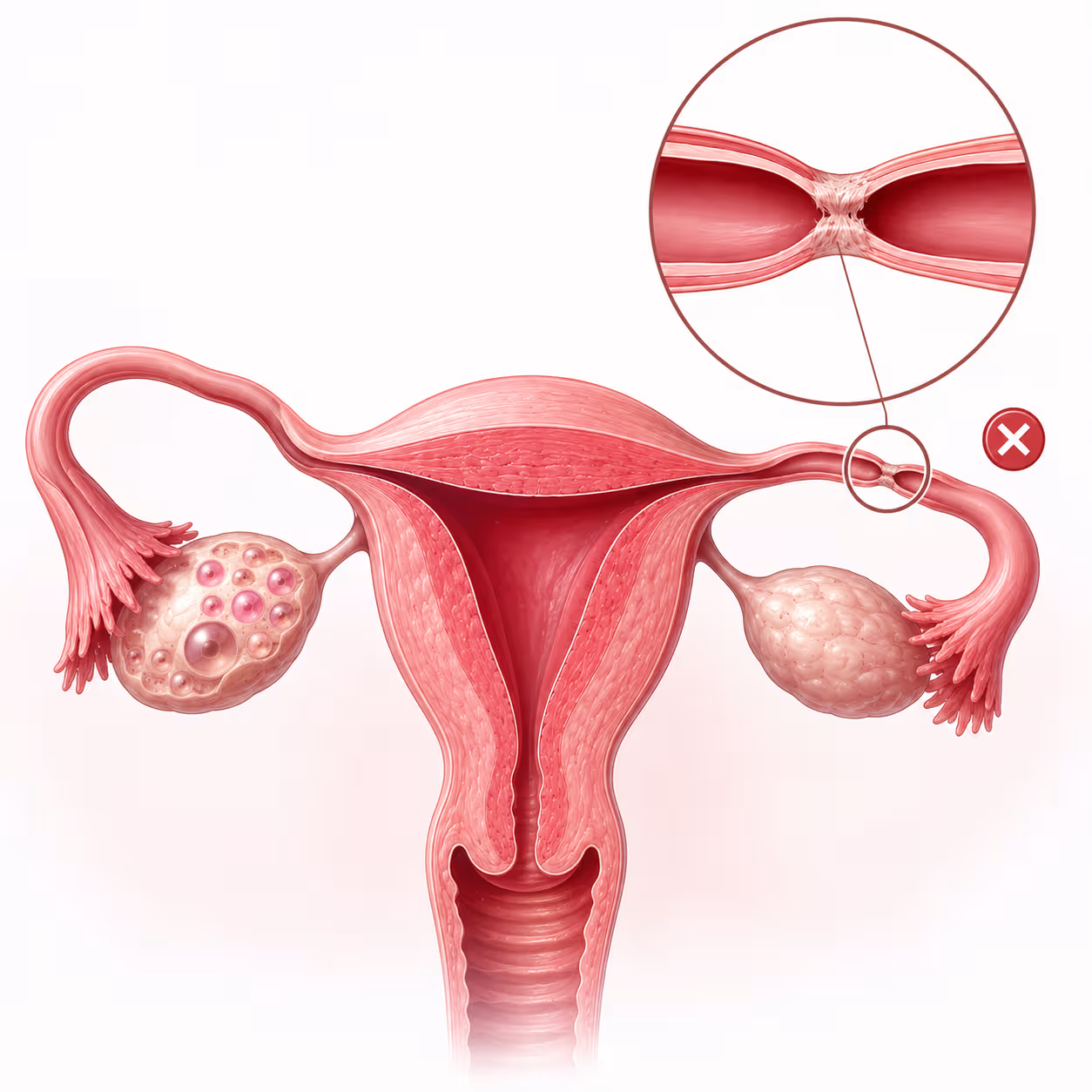
For many women, the diagnosis of “blocked tubes” comes as a complete surprise.  You may have had no symptoms—no pain, no fever, no warning signs—until you started trying to conceive and nothing happened. The fallopian tubes are the essential bridge where life begins. They are where the sperm meets the egg for fertilisation, and where the early embryo travels down to the uterus. If this bridge is closed, natural conception is mechanically impossible.

At Wellspring IVF & Women’s Hospital in Ahmedabad, we see hundreds of patients with tubal factor infertility every year.  Many come to us confused, having been offered “guaranteed” surgeries to open their tubes elsewhere, or having been pushed straight into expensive treatments without a clear diagnosis.

Honest, Anatomical Diagnosis.

We do not just look at whether the tubes are blocked. We look at where they are blocked (proximal vs. distal), how damaged they are (hydrosalpinx vs. simple block), and whether surgery is actually worth your time and money—or if IVF is the faster, safer route to a baby.
Causes of Blocked Fallopian Tubes

Blocked tubes are rarely a congenital defect; they are almost always acquired due to inflammation or scarring. The most common causes in India include:

  • Pelvic Inflammatory Disease (PID): Past infections (often sexually transmitted, like Chlamydia or Gonorrhoea) that went untreated or unnoticed, causing internal scarring.
  • Genital Tuberculosis (TB): A very common and silent cause of tubal damage in India. TB can destroy the delicate inner lining (cilia) of the tubes, making them rigid and functionless even if they appear “open” on an X-ray.
  • Endometriosis: Endometriotic tissue can cause adhesions (bands of scar tissue) that kink, twist, or block the tubes from the outside. See our Endometriosis page.
  • Previous Surgeries: Past surgeries for appendix, ovarian cysts, or fibroids can lead to post-operative adhesions that block the tubes.
  • Ectopic Pregnancy History: If you have had a previous tubal pregnancy, the tube may have been damaged or removed.

Understanding IMSI Treatment

Learn from our experts and get inspired by real patient journeys

Fresh vs. Frozen Embryo Transfer: Which Has Higher Success?
Browse All Videos

Diagnosing Blocked Tubes: The HSG Test

You cannot check for blocked tubes with a standard blood test or a routine consultation scan. The gold standard for initial diagnosis is the HSG (Hysterosalpingogram).

What is an HSG Test?

An HSG is a specialised X-ray procedure. A thin catheter is placed through the cervix, and a safe, iodine-based dye is gently injected into the uterus. As the dye fills the uterus and flows into the fallopian tubes, X-ray images are taken.

  • If tubes are open: The dye spills freely out of the ends of the tubes into the abdominal cavity.
  • If tubes are blocked: The dye stops abruptly at the blockage point, clearly showing the location of the obstruction.

 Is the HSG Painful?

Many women fear the HSG because of horror stories online. At Wellspring IVF, we perform HSG with a “soft-catheter technique” and premedication to minimise cramping. Most patients describe it as similar to strong period cramps—uncomfortable, but brief (less than 5-10 minutes) and manageable.

The Critical Decision: Tubal Surgery (Cannulation) vs. IVF

Once blocked tubes are confirmed, the biggest question is: “Can you open them, or do I need IVF?” The answer depends entirely on the location and severity of the blockage. Dr. Pranay Shah uses this evidence-based decision matrix:

Scenario A: Proximal Block (Block near the uterus)

What it is: The blockage is right where the tube joins the uterus. Often caused by a mucus plug or minor debris.

Treatment: Hysteroscopic Cannulation.

Success Rate: High. Dr. Shah can often guide a thin wire through the blockage to clear it.

Recommendation: Surgery is often worth trying first, especially for younger women.

Scenario B: Distal Block / Hydrosalpinx (Block at the far end)

What it is: The blockage is at the fimbrial end (near the ovary). The tube is often swollen with toxic fluid (Hydrosalpinx).

Treatment: Surgery (Fimbrioplasty) is difficult and re-blockage rates are high.

Recommendation: IVF is strongly recommended. Surgery to open these tubes has a high failure rate and increases the risk of ectopic pregnancy. In fact, we often recommend removing or clipping these tubes before IVF (see Hydrosalpinx section below).

Scenario C: Tubal TB or Severe Scarring

What it is: The tubes are rigid, “lead-pipe” like, or severely damaged by Tuberculosis.

Treatment: These tubes are functionally dead. Even if mechanically opened, the tiny hairs (cilia) inside cannot move the egg.

Recommendation: IVF is the only successful path. Surgery provides false hope.

I am very honest with my patients. If I believe surgery will give you a genuine 30-40% chance of natural conception, I will offer it. But if your tubes are severely damaged, offering surgery is just delaying your parenthood and draining your finances. In those cases, IVF is not a ‘last resort’—it is the smart, direct bypass that solves the problem immediately.”

— Dr. Pranay Shah, MS (ObGy), Director & Chief Fertility Consultant, Wellspring IVF

★★★★★ 4.9/5.0

What Our Patients Say

Real stories from real families who trusted us with their fertility journey
500+ Google Reviews  •  Verified Patient Testimonials

hhhhh

Join 500+ Satisfied Families

Read all our verified Google reviews or share your own experience

Why IVF is the Most Successful Treatment for Blocked Tubes

IVF (In Vitro Fertilisation) was literally invented to treat tubal blockage. It completely bypasses the fallopian tubes.

How IVF Bypasses Blocked Tubes

  1. Egg Collection: We collect eggs directly from your ovaries using a needle (bypassing the tube entrance).
  2. Fertilisation: We fertilise the eggs with sperm in our laboratory (bypassing the tube’s role as the meeting place).
  3. Embryo Transfer: We place the resulting embryo directly into your uterus (bypassing the tube’s transport role).

For women with tubal factor infertility (and normal egg reserve/sperm), IVF success rates are among the highest of all fertility diagnoses, because the rest of the reproductive system is often perfectly healthy.

The Hydrosalpinx Danger: Why We Sometimes Remove Tubes Before IVF

A Hydrosalpinx is a specific type of blocked tube that is filled with toxic, inflammatory fluid. If you have a Hydrosalpinx, simply ignoring it and doing IVF can lead to failure. Why? Because the toxic fluid from the tube can leak backward into the uterus and poison the embryo, or mechanically wash the embryo out.
Dr. Shah's Protocol for Hydrosalpinx

If a Hydrosalpinx is visible on ultrasound, we recommend Laparoscopic Clipping or Delinking of the tube before the embryo transfer. This prevents the fluid from reaching the uterus, significantly doubling the success rate of the subsequent IVF cycle.

Frequently Asked Questions

Find answers to common questions about IVF and fertility treatments. Have a specific question not covered here?
Ask a Question

Start with a Clear Diagnosis

If you have been trying to conceive for more than 12 months (or 6 months if you are over 35) and haven't had an HSG test, this is your first step. Do not waste months on medication or ovulation tracking if the bridge itself is closed.

Come to Wellspring IVF for a clear, honest evaluation. Whether it's a simple unblocking procedure or a bypass via IVF, Dr. Pranay Shah will guide you to the path with the highest probability of holding a baby in your arms.