Blastocyst Culture & Day 5 Embryo Transfer in Ahmedabad
Request a Free Callback
The Embryo Development Journey - Day 0 to Day 5 & Beyond
To understand why blastocyst culture matters, you first need to understand what is actually happening to your embryos inside the incubator — and what happens naturally inside the body during those same days. These two timelines must be perfectly synchronised.
| Stage | Cell Count | Natural Location | What’s Happening |
|---|---|---|---|
| Day 0 | Fertilisation 1 cell (Zygote) | Fallopian tube | Egg + Sperm unite via ICSI. Single cell with two pronuclei visible. |
| Day 1 | Pronuclei Check 2PN Stage | Fallopian tube | Fertilisation confirmed. Failed fertilisation embryos excluded here. |
| Day 2–3 | Cleavage Stage 4–8 cells | Fallopian tube | Old IVF standard. Embryo still in fallopian tube in nature. NOT ready for uterus. |
| Day 4 | Morula Stage 16–32 cells | Entering uterus | Cells compacting. Critical transition begins. Natural position: just entering uterus. |
| Day 5–6 | BLASTOCYST 100–200+ cells | Uterus | ICM + Trophectoderm fully formed. Natural position: inside uterus. CORRECT for transfer. |
Watch Our Blastocyst Culture Video
Learn how Day 5 embryo transfer works, why it optimizes your IVF success rates, and what our advanced embryology lab looks like.
What You Will Learn
- Day 3 vs. Day 5 Reality: Why Day 5 transfer is the modern global standard for IVF success.
- Natural Timing: How aligning with your body’s biological clock improves implantation.
- Higher Success Rates: Why advanced blastocysts have significantly higher pregnancy potential.
- Safer Single Transfers: How selecting the strongest embryo eliminates twin pregnancy risks.
- Fewer Cycles Needed: How maximizing embryo development saves you time and repeated attempts.
The Synchronisation Principle — Why Day 5 Is the Biological Sweet Spot
In a natural pregnancy, the fertilised egg spends the first 4–5 days travelling slowly down the fallopian tube, dividing as it goes. It only enters the uterus on approximately Day 5, when it has reached the blastocyst stage. The endometrium (uterine lining) has its own hormonal clock — it is receptive to embryo implantation for a specific window of roughly 24–48 hours on Days 5–7 after ovulation.
When an embryo is transferred on Day 3, it arrives in the uterus 2 days before it would naturally get there — and crucially, 2 days before the endometrium is prepared to receive it. A Day 5 blastocyst arrives precisely when the window is open. This is not a minor technical difference. It is the biological equivalent of knocking on a door at the exact right moment versus two days early.
The IVF Attrition Rate — Why Fewer Embryos on Day 5 Is Not Bad News
| Stage | Typical Attrition | What This Means |
|---|---|---|
| Eggs Retrieved | 100% (baseline) | e.g. 10 eggs collected |
| Mature Eggs (MII) | 70–80% survive | e.g. 7–8 mature eggs available for ICSI |
| Fertilised (Day 1 — 2PN check) | 70–80% of mature eggs | e.g. 5–6 fertilised normally |
| Cleavage Stage (Day 3) | 80–90% of fertilised | e.g. 4–5 dividing normally |
| Blastocyst Stage (Day 5–6) | 40–60% of Day-3 embryos | e.g. 2–3 blastocysts formed — these are your best embryos |
| Grade AA/AB/BA Blastocysts | 50–70% of blastocysts | e.g. 1–2 top-quality blastocysts for transfer or freezing |
Gardner Grading — How Wellspring Scores Your Blastocysts
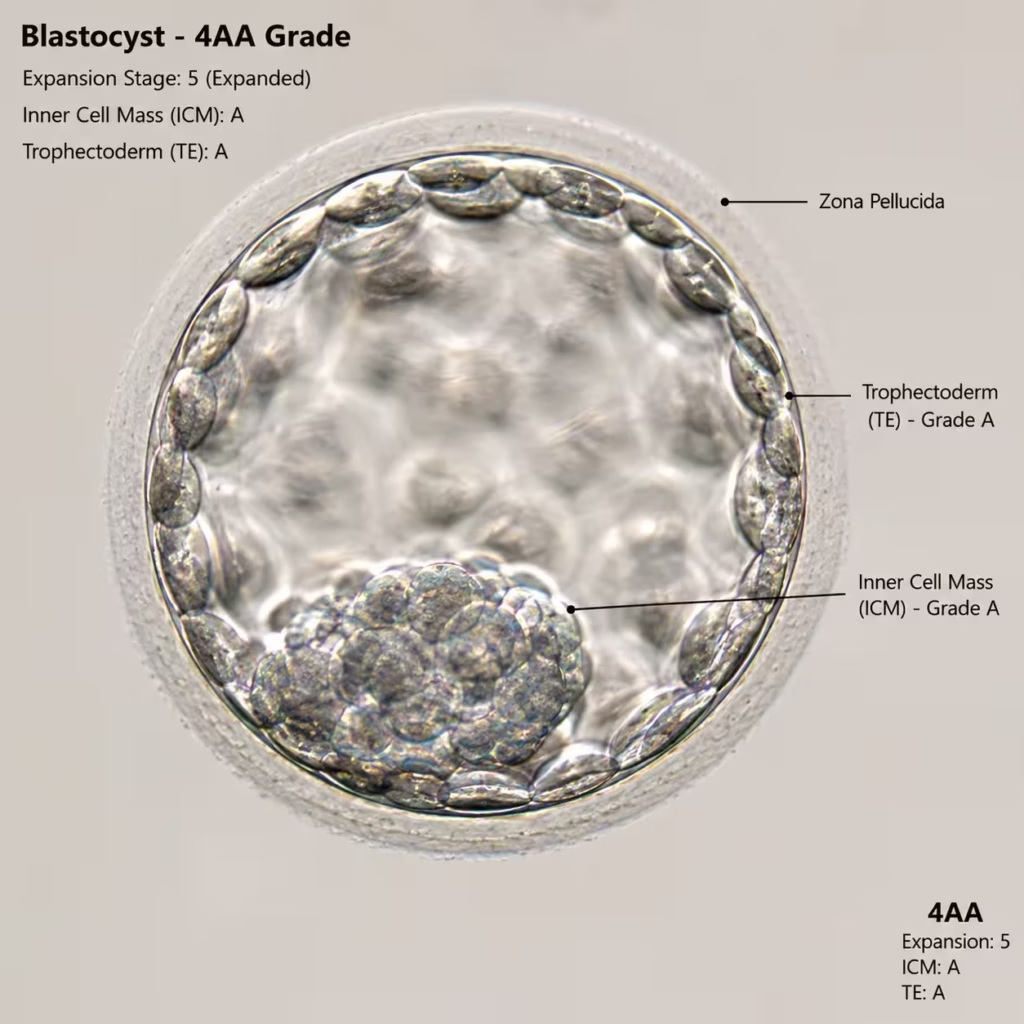
- Inner Cell Mass (ICM): The cells that will form the baby — graded A (excellent), B (good), or C (fair)
- Trophectoderm (TE): The cells that will form the placenta — graded A (excellent), B (good), or C (fair)
- Expansion Grade: How expanded the blastocyst cavity is — graded 1 (early) to 6 (fully hatched)
| Gardner Grade | What It Describes | Clinical Significance |
|---|---|---|
| AA | Excellent ICM + Excellent Trophectoderm | Highest implantation potential. First choice for single embryo transfer (eSET). Freeze priority Grade 1. |
| AB | Excellent ICM + Good Trophectoderm | Very high implantation potential. Routinely transferred or frozen as first priority. |
| BA | Good ICM + Excellent Trophectoderm | Very high implantation potential. Equivalent to AB in most clinical outcomes. |
| BB | Good ICM + Good Trophectoderm | Good implantation potential. Standard choice for transfer if AA/AB/BA not available. |
| BC / CB | Good/Excellent ICM + Fair Trophectoderm (or vice versa) | Moderate implantation potential. May be transferred if higher grades not available. |
| CC | Fair ICM + Fair Trophectoderm | Lower implantation potential. Transferred only if no better-grade embryo is available. |
| Expansion Grade 1–6 | Blastocyst expansion stage (1=early, 6=fully hatched) | Grade 3, 4, 5 (full/expanded/hatching) are ideal. Grade 6 (hatched) is also excellent. |
What Our Patients Say


A special thank you to Dr. Pranay Shah for his confidence, guidance, and the way he explained everything so patiently. His positive approach gave me so much strength, and today I am blessed with my baby.
Thank you to each and every member of the hospital for taking such great care of me and supporting me throughout this journey. Forever grateful. 💕

He is, without a doubt, the most patient doctor I have ever met. Of course, treatment can be done by many. What truly sets him apart is his maturity, the way he pauses, explains, comforts, and most importantly, seeks your permission before moving forward. You never feel rushed. You never feel unheard. You feel respected.
And the staff deserves equal appreciation. They handle even the most anxious and impatient moments with such calm grace and dignity that you slowly find your own heartbeat settling down. It feels less like a clinic and more like a safe space.
I wholeheartedly recommend him to anyone who overthinks, seeks reassurance, or simply needs a doctor who believes comfort is the first step of healing. With him, care begins long before the treatment does.

Highly recommend for their expertise, kindness and dedication. "Turned out dream into reality"



Our gratitude also extends to everyone in your clinic who offered a smile, reassurance, technical support, or a listening ear along the way. We feel incredibly blessed to have chosen your practice for our journey, and we will always cherish the precious gift you helped us receive.
Thank you, from the bottom of our hearts, for making our dream a reality.
Join 750+ Satisfied Families
Blastocyst Culture & PGT-A Genetic Testing - An Inseparable Pair
Why PGT-A Requires Blastocyst Stage
PGT-A biopsy involves removing 5–8 cells from the Trophectoderm (outer layer) of the blastocyst. This layer is large enough at Day 5/6 to allow a safe biopsy without damaging the ICM (the cells that form the baby). At Day 3, the embryo has only 6–8 cells total — a biopsy would remove 1–2 cells and risk severely damaging the embryo.
Without blastocyst culture, PGT-A is not possible. If a patient needs genetic testing — due to recurrent IVF failure, recurrent miscarriage, advanced maternal age, or known chromosomal abnormality — extended culture to Day 5 is a clinical prerequisite, not an optional extra.
The PGT-A + Blastocyst Workflow
Day 5/6: Blastocyst forms → Trophectoderm biopsy performed by embryologist
Same day: Biopsied blastocyst immediately Vitrified (frozen)
Days 7–14: Biopsy sample sent to genetics lab for chromosomal analysis
Results received: Euploid (chromosomally normal) embryos identified
Next cycle: Euploid embryos thawed and transferred in a dedicated FET cycle
Read our full PGS / PGD / PGT-A page for complete detail on genetic testing at Wellspring.
Blastocyst Culture & Single Embryo Transfer (eSET) — Preventing Twin Pregnancies
Higher Confidence Per Embryo
A Grade AA blastocyst has a 50–60% implantation rate per transfer. This high individual probability makes transferring a single embryo medically reasonable — the risk of the transfer failing is acceptably low.
Surplus Embryos Stay Frozen
Any high-quality blastocysts not transferred are Vitrified and stored for future use — either for a second attempt if needed, or for a future sibling. Read about our Embryo Freezing service for full detail.
Prevents High-Risk Twin Pregnancies
Twin pregnancies carry significantly higher risks — premature birth, low birth weight, gestational diabetes, pre-eclampsia, and NICU admission. Transferring one high-quality blastocyst avoids these risks without meaningfully reducing the pregnancy rate.
Your Fertility Consultant
Our fertility specialists are committed to providing personalized, compassionate care with
the latest reproductive medicine techniques.

Dr. Pranay Shah

Divyesh Bhalodia

Urmi Chuhan
Blastocyst Transfer Success Rates — What the Evidence Shows
| Outcome | Day 3 Transfer | Day 5 Blastocyst Transfer | Advantage |
|---|---|---|---|
| Implantation Rate per Embryo | 25–35% | 45–60% | ~70% relative improvement |
| Clinical Pregnancy Rate per Transfer | 35–45% | 50–65% | Consistently higher |
| Live Birth Rate per Transfer (under 35) | 30–42% | 45–58% | Significantly higher |
| Multiple Pregnancy Rate (with eSET) | Higher (multiple embryos transferred) | Lower (eSET feasible) | Safer, comparable success |
| Miscarriage Rate | Higher (more aneuploid embryos transferred) | Lower (natural selection already occurred) | More chromosomally competent embryos |
Your Strongest Embryos. Your Best Chance.
Blastocyst Culture at Wellspring IVF — Our Lab & Technology
Lab Environment Standards
- ISO Class 5 air quality (ultra-clean laminar flow cabinet)
- Continuous CO2 and O2 monitoring — maintained within ±0.1% tolerance
- Temperature-controlled to 37°C — monitored 24 hours
- VOC-free (Volatile Organic Compound) lab environment — no chemical interference
- Anti-vibration workstations for embryo handling
- UV-filtered lighting to prevent photo-damage to embryos
Time-Lapse Embryo Monitoring
- Detection of abnormal cell division patterns that predict poor implantation
- Identification of the specific hour each embryo reaches each developmental milestone
- Better embryo ranking beyond static morphology alone
Frequently Asked Questions
What if none of my embryos reach blastocyst stage?
This is the most feared outcome — and it does happen in a minority of cycles. If no embryos reach blastocyst by Day 5 or 6, the cycle has unfortunately not produced a transferable embryo in that attempt. This outcome is not caused by poor lab conditions at Wellspring — it reflects the biological quality of the embryos themselves. When this happens, Dr. Pranay Shah will conduct a detailed review of the cycle to determine whether a protocol change, additional testing (e.g. sperm DNA fragmentation, ERA test for endometrial receptivity), or an altered stimulation approach may improve outcomes in the next cycle.
My clinic says I have 6 embryos on Day 3. How many will make it to Day 5?
Statistically, 40–60% of Day-3 embryos reach the blastocyst stage by Day 5 or 6. For 6 Day-3 embryos, this means 2–4 blastocysts is the typical expected range. However, there is significant individual variation — some patients get better conversion, some get worse. The quality of Day-3 embryos is the best predictor: embryos with full, regular blastomeres (cells) and minimal fragmentation convert to blastocyst at higher rates than fragmented or irregular ones.
Is blastocyst culture available for all IVF patients at Wellspring?
Extended culture to Day 5 is Wellspring’s standard protocol for all IVF cycles — with one clinical exception. If a patient has very few embryos on Day 3 (typically 1–2), Dr. Shah may recommend a Day-3 transfer to avoid the risk of losing those embryos in extended culture. The choice is always made in the patient’s best clinical interest, not as a blanket policy. This case-by-case decision is discussed with the patient before the transfer day.
What does a blastocyst grade of '4AA' mean?
This is the best possible blastocyst grade under the Gardner grading system: Expansion Stage 4 (fully expanded blastocyst cavity) + ICM Grade A (excellent — tight, prominent inner cell mass) + Trophectoderm Grade A (excellent — cohesive cells with many cells present). A 4AA blastocyst has the highest statistical chance of successful implantation. Even a 3BB blastocyst, however, is a good quality embryo with significant implantation potential.
Does blastocyst culture damage the embryo?
No — when performed in a properly calibrated IVF laboratory (as at Wellspring), extended culture does not cause harm to embryos that are biologically capable of continued development. Embryos that fail to reach blastocyst in the lab would have also failed to develop in the body — they lacked the developmental capacity from the start. The lab environment at Wellspring is engineered to replicate the natural fallopian tube conditions as closely as possible, including temperature, pH, gas mixture, and absence of light and chemical interference.
Can frozen blastocysts be used in a later cycle?
Yes — this is one of the key advantages of blastocyst culture. All high-quality blastocysts not transferred in the fresh cycle are Vitrified (flash-frozen) and stored for future use in a Frozen Embryo Transfer (FET) cycle. Published data consistently shows that frozen blastocysts achieve success rates equal to or better than fresh blastocyst transfers in many clinical scenarios — because the FET cycle allows the endometrium to be prepared in an optimal hormonal environment, separate from the stimulation cycle.
What is the cost of blastocyst culture in Ahmedabad?
Blastocyst culture is not a separate add-on cost at Wellspring IVF — it is included within the standard IVF treatment package as the default embryo culture protocol. Extended culture to Day 5 is part of the laboratory process, not an upgradeable feature. The complete IVF package cost, including embryo culture, monitoring, and transfer, is discussed transparently at your initial consultation. Call 9099946050 for current pricing.
Related Insights & Articles
 Blocked fallopian tubes can make it hard for a woman to get pregnant. But there are ways to treat this…June 11, 2026
- Are you feeling worried about low AMH and IVF? You are not alone. Many women have to face the same…June 11, 2026
- Can You Increase AMH Levels Naturally? What Science Says About Low AMH and Fertility Quick Answer In most cases, AMH…June 11, 2026