
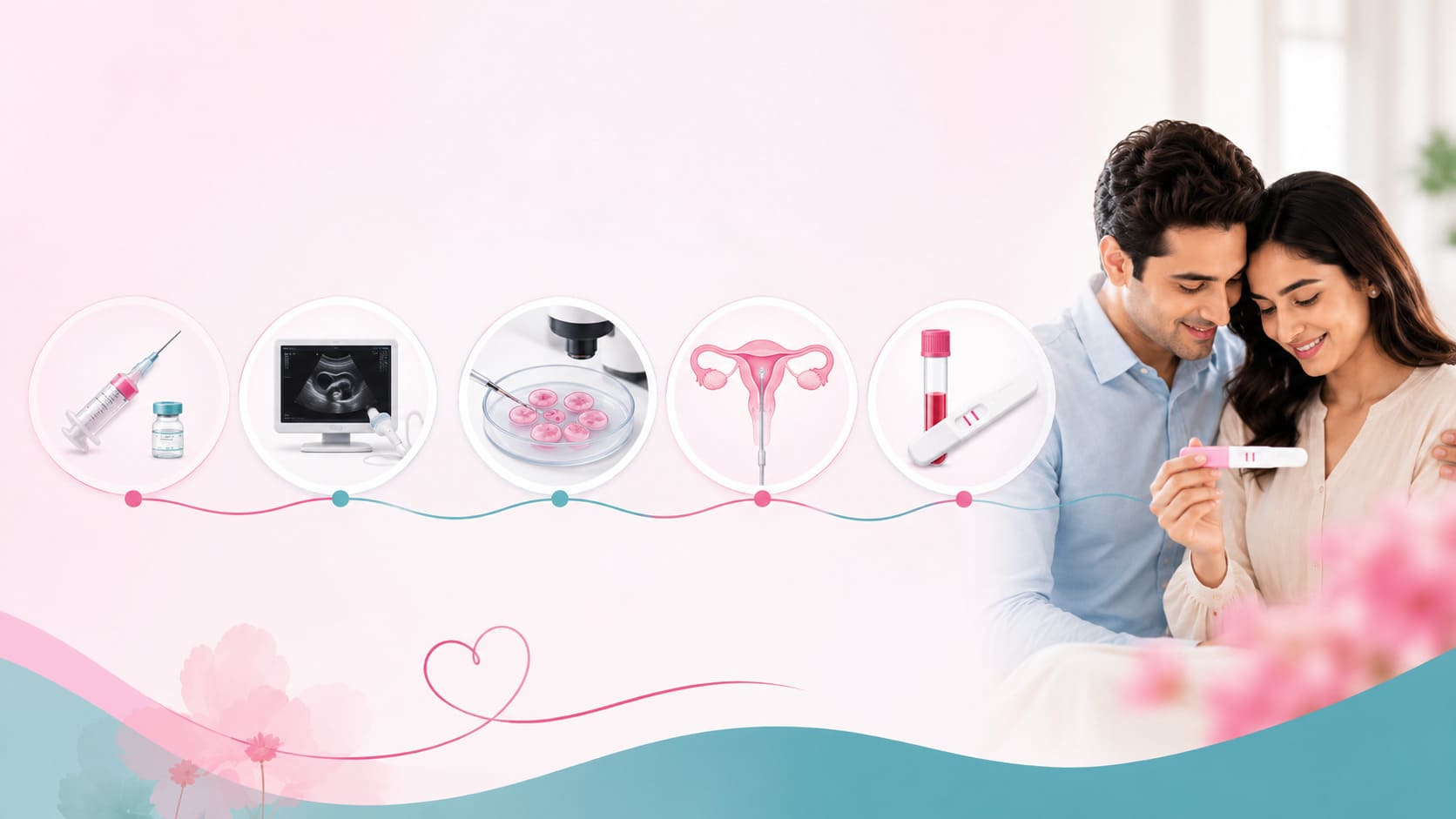
Most patients starting their first IVF cycle describe the same feeling: overwhelmed by a process they do not fully understand, anxious about injections they have never given, and unsure what each monitoring appointment is actually checking. That uncertainty is entirely unnecessary — because the IVF timeline, when explained clearly, is a logical, predictable sequence of events that most couples find far less daunting than they imagined before they started.
This is a complete, day-by-day guide to a standard IVF cycle at Wellspring IVF. It covers every phase — from the initial investigations before stimulation starts, through each monitoring visit during stimulation, the egg retrieval procedure, what happens to your embryos in the laboratory, the embryo transfer, and the two-week wait before the pregnancy test. Nothing is skipped or softened.
Understanding the process also means understanding the decision points — the moments during your cycle where the clinical team makes adjustments based on your response. The IVF timeline is not rigid: it is a protocol with precision checkpoints, and knowing what each checkpoint is measuring gives you the ability to participate meaningfully in your own treatment, not just follow instructions.
This article also links to the dedicated clinical pages on our site for each treatment component, so you can read as deeply into any specific step as you choose. Start here: IVF Treatment at Wellspring IVF, Ahmedabad.
Before Stimulation Begins: Pre-IVF Investigations and Preparation
The IVF cycle officially begins on Day 1 of your period — but the work that determines the protocol has already been done in the weeks and months before. A thorough pre-IVF workup is not optional: it is the clinical foundation that makes the protocol safe, personalised, and appropriately dosed.
Female Partner Investigations
- Hormonal panel (Day 2–3 of period): FSH, LH, Estradiol (E2), AMH, TSH, Prolactin. Establishes ovarian reserve and baseline hormonal status. AMH and antral follicle count together determine starting stimulation dose.
- Antral Follicle Count (AFC): Transvaginal ultrasound to count small resting follicles in both ovaries — the primary predictor of stimulation response. Low AFC = poor responder protocol; high AFC (as in PCOS) = low-dose caution protocol.
- Uterine cavity assessment: Hysterosonography, saline infusion sonography, or 3D ultrasound. Detects polyps, fibroids, or a septum that could reduce implantation rates. If a cavity anomaly is found, hysteroscopy is performed before starting IVF.
- Tubal patency: HSG or laparoscopy — though for IVF cycles, tubal assessment is less critical (embryo transfer bypasses the tubes), it identifies hydrosalpinx which must be addressed before transfer.
- Infectious disease screen: HIV, HBsAg, HCV, VDRL, Rubella IgG for both partners — mandatory for any ART procedure under Indian regulations.
Male Partner Investigations
- Semen analysis: Volume, concentration, total count, motility (PR+NP), morphology (Kruger). Determines whether ICSI is required.
- DNA Fragmentation Index (DFI): Recommended when there is a history of failed cycles or recurrent miscarriage. High DFI may change the sperm source from ejaculated to testicular.
- Hormonal panel if SA is severely abnormal: FSH, LH, testosterone, prolactin — to investigate cause of severe oligospermia or azoospermia.
Pre-cycle optimisation: Depending on findings, Dr. Shah may prescribe a pre-cycle phase including metformin (for PCOS with insulin resistance), progesterone to synchronise a new cycle, or a short OCP pill to schedule cycle start. Weight optimisation, folic acid (400–800 mcg daily), and vitamin D correction are addressed during this phase.
The Complete IVF Timeline at a Glance
| Phase | Days (Approximate) | What Happens |
|---|---|---|
| Pre-Cycle Preparation | Weeks 1–8 before start | Investigations, results review, protocol prescription, consent |
| Baseline Scan | Day 1–2 of period | Confirm ovaries are quiet; baseline E2 and AFC; commence gonadotrophins |
| Ovarian Stimulation | Day 2–12 (variable) | Daily FSH/LH injections; monitoring scans Day 5, 7, 9+ ; dose adjustments |
| Antagonist Addition | Day 5–6 or follicle 14mm | GnRH antagonist injection added to prevent premature ovulation |
| Trigger Injection | Day 10–14 (when ready) | hCG or GnRH agonist trigger; egg retrieval scheduled 34–36 hrs later |
| Egg Retrieval (OPU) | Day 12–16 (variable) | Day procedure under sedation; typically 8–20 eggs collected |
| Fertilisation & ICSI | OPU Day (Day 0) | Embryologist strips oocytes; ICSI performed; fertilisation check next day |
| Day 1 Check | Day 1 post-OPU | Fertilisation confirmation: 2PN (normally fertilised) embryos identified |
| Day 3 Check | Day 3 post-OPU | Embryo development assessment (6–8 cell stage); select for Day 5 |
| Blastocyst Culture | Day 5–6 post-OPU | Blastocyst grading (Gardner system); vitrification if freeze-all; biopsy for PGT-A if indicated |
| Fresh Embryo Transfer | Day 3 or Day 5 post-OPU | If fresh transfer: transfer best embryo(s); luteal support medications begin |
| FET Prep (Freeze-All) | Following month | Endometrial preparation: oestrogen + progesterone; lining scan; transfer day |
| Embryo Transfer (FET) | Day 14–18 of FET prep | Ultrasound-guided transfer; rest same day; luteal support continues |
| Two-Week Wait | 14 days post-transfer | Progesterone/oestrogen support continues; symptom management; blood test scheduled |
| Beta-hCG Test | Day 14 post-transfer | Serum pregnancy test; if positive, repeat in 48 hrs to confirm rising trend |
| Viability Scan | Day 28–35 post-transfer | Transvaginal scan to confirm heartbeat and location (rule out ectopic) |
Phase 1 — Baseline Assessment: Day 1–2 of Your Period
Day 1 is defined as the first day of full menstrual flow. You call or WhatsApp the clinic on Day 1. A baseline transvaginal ultrasound and blood tests (E2, sometimes LH) are scheduled for Day 2 or Day 3.
The baseline scan checks for:
- Ovarian cysts — if a functional cyst is present (estradiol-secreting), the cycle may be delayed by 1–2 weeks until it resolves naturally or is aspirated
- Antral follicle count — the small resting follicles that will be recruited during stimulation
- Endometrial status — confirming the uterine lining has shed fully
- Baseline E2 level — if elevated above threshold, stimulation start is deferred
If baseline is clear: stimulation begins that same evening or the following morning. Your first gonadotrophin injection is the formal start of the IVF cycle.
Phase 2 — Ovarian Stimulation: Day 2 to Day 10–14
Ovarian stimulation is the engine room of the IVF cycle — and the phase where the most clinical decision-making happens. The goal is to recruit and grow multiple follicles simultaneously to a mature size (18–20 mm), while preventing the spontaneous LH surge that would cause premature ovulation before egg retrieval.
The Gonadotrophin Injections
Stimulation medications are FSH-based gonadotrophins — either pure recombinant FSH (e.g., Gonal-F, Puregon), combined FSH+LH preparations (e.g., Menopur, Pergoveris), or biosimilars. They are self-administered as subcutaneous injections — typically in the lower abdomen — at the same time each evening. Most patients report the injections as far less painful than anticipated — a small, short needle with a fine gauge.
Starting dose is calibrated based on AMH, AFC, body weight, age, and prior response (if a previous cycle was done). Typical starting doses range from 100 IU (low-dose PCOS protocol) to 300 IU (poor responder). The dose is adjusted at each monitoring visit based on follicle response.
The Antagonist Injection
From approximately Day 5–6 of stimulation — or when the leading follicle reaches 14 mm — a second injection is added: the GnRH antagonist (Cetrotide or Orgalutran). This prevents the premature LH surge that would cause the follicles to ovulate before egg retrieval. The antagonist is taken alongside the stimulation injection until the trigger night.
Monitoring Visits During Stimulation
| Monitoring Visit | Typical Day | What Is Assessed | What Happens After |
|---|---|---|---|
| Scan 1 | Day 5 | Early follicle development; E2 rising appropriately | Dose maintained or adjusted; confirm antagonist start day |
| Scan 2 | Day 7 | Follicle count and size; E2 level | Dose fine-tuned; any signs of over-response managed |
| Scan 3 | Day 9 | Follicle sizes approaching 16–18 mm; LH, E2, P4 | Trigger readiness assessed; day 10 final scan often planned |
| Scan 4 | Day 10–12 | Leading follicles at 18–20 mm; final trigger decision | Trigger injection prescribed; egg retrieval scheduled |
📍 What You Will Feel During Stimulation:
- Mild to moderate pelvic heaviness or bloating — normal as follicles grow
- Breast tenderness — from rising estrogen
- Mood fluctuations — gonadotrophins have a hormonal effect on mood in some patients
- Fatigue — common from the hormonal load; rest when possible
- Abdominal distension — particularly in PCOS patients with high follicle counts
Important: Sudden severe abdominal pain, significant weight gain (>1 kg in 24 hours), or reduced urine output are warning signs of early OHSS. Contact Wellspring immediately if these occur.
Phase 3 — The Trigger Injection: 34–36 Hours Before Egg Retrieval
The trigger injection is the most time-critical step in the entire IVF cycle — and the one that requires absolute precision. It is given at a specific, agreed time — most commonly between 10 PM and midnight — and egg retrieval is scheduled exactly 34–36 hours later. Timing error at this step means immature or already-ovulated eggs at retrieval.
The trigger mimics the natural LH surge, causing the follicles to undergo the final maturation steps that convert the oocyte from an immature (germinal vesicle) state to a mature (MII) state ready for fertilisation.
Two Types of Trigger — Different Clinical Decisions
| Trigger Type | Drug Used | Who It Is For | Key Advantage |
|---|---|---|---|
| hCG trigger | Ovitrelle (recombinant hCG) or Pregnyl (urinary hCG) | Standard responders; fresh transfer planned | Very reliable maturation trigger; standard of care |
| GnRH agonist trigger | Decapeptyl / Lupride 0.2 mg SC | PCOS / high responders; freeze-all planned | Significantly reduces severe OHSS risk — the primary safety advantage for high-AFC patients |
| Dual trigger | hCG + GnRH agonist (same night) | Poor responders; empty follicle history | Maximises maturation rate in patients prone to low yield at retrieval |
Note: For PCOS patients and all patients where Dr. Shah plans a freeze-all strategy, the GnRH agonist trigger is used. For patients where a fresh transfer is planned in a standard responder, the hCG trigger is used. This is one of the key personalised decisions in PCOS IVF protocols.
Phase 4 — Egg Retrieval (OPU): What Happens on the Day
OPU — Oocyte Pick-Up — is a day procedure performed at Wellspring IVF under IV sedation (not general anaesthesia). You are comfortably asleep. The entire procedure typically takes 15–30 minutes.
What Happens During OPU
- You arrive fasting (no food or water for 6 hours). IV access is placed; sedation is administered.
- A transvaginal ultrasound probe with a needle guide is used to visualise the follicles. A thin aspiration needle passes through the vaginal wall into each follicle.
- Each follicle is aspirated — the follicular fluid (containing the egg) is collected into a heated tube and immediately handed to the embryologist in the adjacent laboratory.
- The embryologist identifies the egg(s) under the microscope in real time. Dr. Shah and the team know the egg count before you wake up.
- You recover in the clinic for 1–2 hours. Minor cramping and light spotting are normal. Most patients go home and rest the same day.
Understanding Your Egg Count
| Eggs Retrieved | Context | Clinical Expectation |
|---|---|---|
| 1–4 eggs | Poor responder / Low AMH / Advanced age | Lower but still meaningful chance with each mature egg; each fertilised egg is an opportunity |
| 5–12 eggs | Average responder | Good yield; typically produces 2–5 blastocysts; standard IVF success range |
| 13–20 eggs | Good / High responder | Strong yield; freeze-all strategy often planned; likely 4–10 blastocysts |
| 20+ eggs | High responder (PCOS typical) | Freeze-all mandatory; OHSS monitoring heightened; excellent embryo pool for multiple attempts |
Not all retrieved eggs will be mature. Typically 70–80% of retrieved eggs are mature (MII). Not all mature eggs will fertilise. Not all fertilised eggs will reach blastocyst stage. This attrition is normal embryo development — not a failure of your IVF cycle. For the specific protocol for patients with low egg yield, see: IVF Protocol for Low AMH.
Phase 5 — The Embryology Laboratory: Day 0 to Day 5–6
This is the phase patients understand least — because it happens in the laboratory, without them. It is also where some of the most significant clinical decisions are made.
Day 0: Fertilisation by ICSI
In most IVF cycles at Wellspring — particularly where the male partner’s semen analysis shows any abnormality — fertilisation is performed by ICSI (Intracytoplasmic Sperm Injection): the embryologist uses a glass microneedle under high magnification to inject a single selected sperm directly into each mature egg. ICSI fertilisation rates are typically 70–80% of mature eggs.
Day 1: Fertilisation Check
The embryologist checks each egg under the microscope for the presence of two pronuclei (2PN) — one from the egg, one from the sperm. This confirms normal fertilisation. The number of 2PN embryos is your ‘starting squad’ for the rest of development.
Day 3: Cleavage Stage Assessment
By Day 3, normally developing embryos should have divided into 6–8 cells. In most protocols at Wellspring, we do not transfer on Day 3 — we continue culture to blastocyst stage, because blastocyst selection significantly improves the quality of the embryo transferred.
Day 5–6: Blastocyst Stage
Blastocysts are expanded embryos that have developed a fluid-filled cavity (blastocoel) and differentiated into two cell types — the inner cell mass (which becomes the baby) and the trophectoderm (which becomes the placenta). Only embryos with the developmental competence to reach blastocyst stage progress to this point. Blastocysts are graded using the Gardner grading system. See: Blastocyst Culture at Wellspring IVF.
📊 Typical Embryo Attrition — What Is Normal:
Example: 12 eggs retrieved → 9 mature → 7 fertilised → 6 reach Day 3 → 3–4 blastocysts. This is a good, expected outcome — not a failure at any step.
Genetic Testing: PGT-A (When Indicated)
For selected patients — advanced maternal age (≥38), recurrent miscarriage, prior IVF failures — a small biopsy of the trophectoderm cells of each blastocyst is taken on Day 5–6 and sent for chromosomal analysis. This is PGT-A (Preimplantation Genetic Testing for Aneuploidies). Euploid (chromosomally normal) embryos have significantly higher implantation rates and lower miscarriage rates than untested embryos.
Phase 6 — The Transfer Decision: Fresh Cycle or Freeze-All Strategy
This decision — made by Day 5 of the stimulation phase, often earlier — has a significant impact on both safety and outcomes. It is one of the most important clinical judgements in IVF.
| Scenario | Fresh Transfer (Same Cycle) | Freeze-All + FET |
|---|---|---|
| Best for | Normal responders; E2 <3,000 pg/mL on trigger day; uterine lining ideal; no OHSS risk | PCOS; high responders; elevated P4 on trigger day; thin endometrium; OHSS risk; all PGT-A cycles |
| Timing | Day 3 or Day 5 after OPU | Embryos frozen; FET cycle in following month |
| OHSS risk | Present — fresh transfer amplifies OHSS if it occurs | Eliminated — transfer in recovered ovaries |
| Outcomes | Comparable in standard responders | Equal or superior in PCOS; superior in elevated P4 cycles |
For a complete comparison of protocols, outcomes data, and who benefits from each approach: Fresh IVF Cycle vs Frozen Embryo Transfer.
Phase 7 — Embryo Transfer: The Procedure
Embryo transfer is the most anticipated — and often the most anticlimactic — step in the entire IVF process. Most patients expect it to feel significant. It takes approximately 5–10 minutes and is described by most as less uncomfortable than a routine gynaecological examination.
For a Fresh Transfer (Day 5 Post-OPU)
No additional medications are typically needed for endometrial preparation — the natural estrogen environment from stimulation has already prepared the lining. Progesterone (vaginal pessaries or injections) is started from OPU day to support the luteal phase.
For a Frozen Embryo Transfer (FET) Cycle
The uterine lining is prepared over approximately 12–16 days using oral/transdermal estrogen, followed by progesterone. A lining scan confirms adequate endometrial thickness (typically ≥7–8 mm with trilaminar pattern) before transfer is scheduled. The frozen blastocyst is thawed on transfer day — survival rate for vitrified blastocysts at Wellspring’s andrology lab is >95%.
The Transfer Procedure Itself
- No anaesthesia required — the procedure is nearly painless for most patients.
- Ultrasound guidance: a transabdominal ultrasound is used throughout, allowing Dr. Shah to visualise the catheter entering the uterine cavity and confirm embryo placement at the correct position in the fundus.
- The embryo is loaded in a very small volume of fluid into a thin, flexible catheter. The catheter is passed through the cervix into the uterus. The embryo is gently deposited.
- You lie on the table for 10 minutes after transfer. You do not need bed rest — walking to your car and resuming normal light activity is appropriate.
- Luteal support medications (progesterone + estrogen for FET cycles) continue until the Beta-hCG test and, if positive, until 10–12 weeks of pregnancy.
How many embryos to transfer: At Wellspring, single embryo transfer (SET) is the standard recommendation for Day 5 blastocysts — particularly in young patients with good-quality embryos. The risk of twins with double embryo transfer is a clinical and obstetric concern, not a benefit. Dr. Shah discusses individualised transfer strategy at the pre-transfer consultation.
Phase 8 — The Two-Week Wait: What Is Actually Happening
The 14 days between embryo transfer and the pregnancy test is the hardest part of the IVF process for most patients — and it is not a waiting period in any passive sense. Implantation, if it occurs, happens between Day 6 and Day 10 post-transfer.
What Is Happening Inside
| Days Post-Transfer | What Is Happening Biologically |
|---|---|
| Day 1–2 | Blastocyst continues expanding; zona pellucida dissolves (hatching) |
| Day 3–4 | Blastocyst makes first contact with the endometrial lining (apposition) |
| Day 5–6 | Implantation begins — trophectoderm cells begin invading the endometrium |
| Day 7–9 | hCG begins to be produced by the implanting embryo — levels begin rising |
| Day 10–12 | hCG levels detectable in urine (home tests may turn positive) |
| Day 14 | Serum Beta-hCG measured — the official clinical pregnancy test |
Symptoms During the Two-Week Wait
Symptoms That Do NOT Indicate a Failed Cycle:
- No symptoms at all — many patients with successful implantation feel nothing
- Mild cramping — can occur with both successful implantation and as a progesterone side effect
- Light spotting (Days 6–10) — implantation bleeding is possible; spotting does not mean failure
Symptoms That Do NOT Guarantee a Positive Result:
- Breast tenderness, bloating, nausea — all common progesterone side effects regardless of outcome
- A positive home urine test before Day 14 — possible but not a reliable substitute for Beta-hCG
The single most reliable indicator is the Day 14 serum Beta-hCG. Everything else in the 2WW is noise.
For evidence-based psychological strategies during the two-week wait, see our fertility wellness article: The Two-Week Wait: How to Cope With the Hardest Part of IVF.
Phase 9 — Beta-hCG Test and What the Result Means
The serum Beta-hCG is a quantitative blood test — it does not just tell you ‘positive’ or ‘negative’; it gives a number. Understanding that number matters.
| Beta-hCG Result (Day 14 post-transfer) | Interpretation | Next Step |
|---|---|---|
| < 5 mIU/mL | Negative — no implantation detected | Discuss cycle review with Dr. Shah; plan next steps |
| 5–25 mIU/mL | Borderline — biochemical pregnancy possible | Repeat in 48 hours; needs to at least double to be progressing |
| 25–100 mIU/mL | Positive — early clinical pregnancy | Repeat in 48 hrs to confirm doubling; continue medications |
| 100–500+ mIU/mL | Strong positive | Continue medications; viability scan booked at 6–7 weeks |
A positive Beta-hCG does not mean the pregnancy is confirmed as clinically viable. The next milestone is the viability scan at 6–7 weeks — when a gestational sac, yolk sac, and ideally a fetal heartbeat can be confirmed. Continue all medications until explicitly told to stop by Dr. Shah.
What Happens If the Cycle Fails?
A failed IVF cycle is not a closed door — it is a data point. After every unsuccessful cycle, Dr. Shah conducts a formal cycle review: analysing stimulation response, fertilisation and development data, transfer conditions, and any available implantation indicators. This review informs protocol changes for the next attempt.
For patients with more than two failed cycles, a systematic investigation into recurrent implantation failure is initiated — covering endometrial receptivity, thrombophilia, immune factors, and embryo quality. No IVF failure at Wellspring goes unanalysed.
💬 Dr. Shah’s Clinical Bottom Line
“The patients who cope best with an IVF cycle — psychologically and physically — are the ones who understood the process before it started. They know why each injection is given, what each scan is checking, and what the embryologist’s Day 5 call means. They are not surprised by the stimulation bloating or by an unexpected freeze-all decision. They walk into each stage as a participant, not a passenger.”
“At Wellspring, we invest significant time in that preparation — the pre-cycle consultation, the protocol walk-through, the daily support line during stimulation. IVF is not something we do to you. It is something we do with you, at every step. If you have a question at 11 PM about your injection, we want you to ask it — not lie awake guessing.”
— Dr. Pranay Shah | Director & Chief Fertility Consultant, Wellspring IVF | WhatsApp: +91 9099946050
Frequently Asked Questions — IVF Process
Q1: How long does one complete IVF cycle take from start to pregnancy test?
A standard IVF cycle — stimulation to pregnancy test — takes approximately 4–6 weeks from Day 1 of the period. If a freeze-all strategy is used (as is standard for PCOS patients and many others at Wellspring), add another 4–6 weeks for the FET cycle. Total timeline from stimulation start to pregnancy test in a freeze-all cycle: approximately 8–12 weeks.
Q2: How many injections do I need to give myself, and is it painful?
During ovarian stimulation, you administer one to two subcutaneous injections per evening — the gonadotrophin (FSH) from Day 1 of stimulation, and the antagonist added from approximately Day 5–6. Both are self-injected into the lower abdomen using a thin, short needle. The vast majority of patients rate the pain as a 1–2 out of 10 — a brief, mild sting. Our nurses demonstrate the technique at your first injection appointment and are available via WhatsApp for any guidance.
Q3: Can I work during the IVF cycle?
Yes — most patients continue working throughout stimulation. Monitoring scans are typically scheduled in the morning (before work hours). The day of egg retrieval and the day after require rest. The embryo transfer day itself is short (30–45 minutes at the clinic), and most patients return to sedentary work the following day. Avoid high-intensity exercise from stimulation start through the pregnancy test.
Q4: What if fewer eggs than expected are retrieved?
If fewer eggs are retrieved than anticipated — particularly in poor responders — each fertilised egg still represents a meaningful opportunity. For patients with very low response, Dr. Shah may recommend embryo accumulation across multiple stimulation cycles (pooling embryos from 2–3 cycles before transfer) or a modified Mini-IVF or DuoStim protocol — a double stimulation approach within a single cycle. The appropriate response to a low yield depends on the complete clinical picture.
Q5: Can I do anything to improve my chances during the stimulation phase?
During the stimulation phase, the most impactful things you can do are: take medications exactly as prescribed at the agreed times, attend every monitoring scan, stay well-hydrated (particularly important for PCOS patients), avoid alcohol completely, avoid strenuous exercise, and manage stress where possible — elevated cortisol does not directly block IVF success, but it affects sleep and physical recovery. Supplements prescribed in the pre-cycle phase (CoQ10, vitamin D) continue during stimulation if instructed.
