Altruistic Surrogacy in Ahmedabad
Request a Free Callback
What Is Altruistic Surrogacy? — The Foundation of Indian Law
Under the Surrogacy (Regulation) Act, 2021 (Act No. 47 of 2021), India completely banned commercial surrogacy. Only Altruistic Surrogacy is now legally permitted. The Act defines altruistic surrogacy in Section 2(b) as:
“Altruistic surrogacy means the surrogacy in which no charges, expenses, fees, remuneration or monetary incentive of whatever nature, except the medical expenses and such other prescribed expenses incurred on surrogate mother and the insurance coverage for the surrogate mother, are given to the surrogate mother or her dependents or her representative.”
What the Intending Parents CAN Pay
- Documented medical expenses directly related to the surrogate’s pregnancy, delivery, and postpartum care
- A 36-month insurance policy from an IRDAI-recognised insurer covering postpartum delivery complications — mandatory before procedures begin (Section 4(iii)(a)(III))
These are the ONLY two permitted categories of financial outlay to or for the surrogate.
What Is Commercial Surrogacy — and Why Is It a Criminal Offence
Any payment, reward, benefit, gift, or monetary incentive beyond medical expenses and insurance — in cash or kind — to the surrogate or her family is commercial surrogacy under Section 2(g). The penalty is up to 10 years imprisonment + ₹10 lakh fine (Section 38(2)). Every offence is cognizable, non-bailable, and non-compoundable (Section 43).
Legal Timeline — The Surrogacy Act and All Amendments (2021–2024)
The surrogacy legal framework has been amended three times since the Act came into force. The February 2024 amendment is the current applicable law — particularly on the donor gamete question, which had caused significant clinical and legal uncertainty.
Date | Amendment / Event | Legal Effect |
|---|---|---|
Dec 25, 2021 | Surrogacy (Regulation) Act, 2021 enacted | Parliament passes Act No. 47 of 2021. Commercial surrogacy fully banned. Only altruistic surrogacy permitted, exclusively for Indian citizens with a certified medical indication. |
Jan 25, 2022 | Act comes into force | Gazette Notification S.O. 292(E). Registration of surrogacy clinics begins under the new framework. |
Jun 21, 2022 | Surrogacy (Regulation) Rules, 2022 notified | Principal Rules (G.S.R. 460(E)). Detailed eligibility criteria, forms, and procedures prescribed. ‘Close relative’ surrogate requirement was in force at this stage. |
Mar 14, 2023 | Surrogacy (Regulation) Amendment Rules, 2023 | G.S.R. 179(E): Surrogate mother no longer required to be a ‘close relative.’ Any willing woman known to the couple may act as surrogate. Donor gametes still prohibited for couples; single women (widow/divorcee) may use donor sperm. |
Oct 2023 | Supreme Court — Arun Muthuvel v. Union of India | SC allows donor egg use for women with MRKH Syndrome. Court holds that blanket prohibition on donor gametes is prima facie contrary to the objective of the Act. Sets precedent for Feb 2024 amendment. |
Feb 21, 2024 | Surrogacy (Regulation) Amendment Rules, 2024 — CURRENT LAW | MoHFW Gazette: ONE donor gamete permitted when a District Medical Board certifies medical necessity. Child must retain at least one gamete from the intending couple. Single women unchanged — self-eggs + donor sperm. THIS IS THE CURRENTLY APPLICABLE LAW. |
Who Is Eligible for Surrogacy? — Intending Parent Criteria
Surrogacy under Indian law is a medical-necessity pathway — not an elective reproductive choice. Eligibility is narrowly defined, age-bound, and requires independent certification by a government District Medical Board.
Married Couple Eligibility
- Section 4(iii)(c), Surrogacy Act 2021
- Legally married Indian man and woman
- Wife: 23 to 50 years of age at certification
- Husband: 26 to 55 years of age at certification
- Medical indication from District Medical Board (gestational surrogacy medically necessary)
- No surviving child (biological, adopted, or via earlier surrogacy)
- Exception: Existing child has a life-threatening disorder, severe physical/mental disability, or fatal illness with no permanent cure — DMB certificate required
- Couples with a surviving healthy child are NOT eligible
Single Woman Eligibility
- Section 2(s), Surrogacy Act 2021
- Indian widow or divorcee only
- Age: 35 to 45 years at time of certification
- Medical indication required (same as couple)
- Must use her own eggs (self-oocytes)
- Donor sperm is permitted for single women
- Single men are NOT eligible under current law
- Never-married women are NOT eligible
- Live-in couples are NOT eligible
- Same-sex couples are NOT eligible under current law
Three Mandatory Certificates Before Surrogacy Can BeginUnder Section 4(iii), no registered surrogacy clinic can initiate any procedure until all three of the following certificates are in place:
Note: Eligibility certificates are valid for one year from issuance. Couples and their identified surrogate must approach the Appropriate Authority together. Advertising to find a surrogate is illegal under Section 3(v). |
Your Fertility Consultant
Our fertility specialists are committed to providing personalized, compassionate care with
the latest reproductive medicine techniques.

Dr. Pranay Shah

Divyesh Bhalodia

Urmi Chauhan
Who Can Be a Surrogate Mother? — Legal Eligibility Criteria
The Act provides strict criteria under Section 4(iii)(b) to protect the health and rights of the surrogate. These are not advisory guidelines — they are legal conditions that the Appropriate Authority must verify before issuing an eligibility certificate.
Legal Requirements for Surrogate Mothers
- A WILLING woman — written informed consent in her own language is mandatory before any procedure (Section 6). Coercion is illegal.
- Any willing woman known to the couple (since the March 2023 Amendment — the ‘close relative’ requirement has been removed)
- An ever-married woman with at least one biological child of her own
- Between 25 and 35 years of age on the day of implantation
- Permitted to act as a surrogate mother ONLY ONCE in her lifetime
- Must NOT provide her own gametes — the surrogate cannot donate eggs for the surrogacy (Section 4(iii)(b)(III))
- Must hold a Certificate of Medical and Psychological Fitness from a registered medical practitioner
Withdrawal Right: The surrogate may withdraw consent any time before the embryo is physically implanted in her womb (Section 6(2)).
Rights and Protections Built Into the Law
Rights of the Child (Section 8):
A child born through approved surrogacy is deemed the biological child of the intending couple from the moment of birth — with all the rights of a natural child. The surrogate has no parental rights or obligations.
Prohibition on Abandonment (Section 7):
The intending couple cannot abandon the child under any circumstance — including genetic defects, birth defects, sex of the child, or multiple births.
Prohibition on Forced Abortion (Section 10):
No person or clinic can force the surrogate to abort. Abortion during surrogacy requires both the surrogate’s written consent and Appropriate Authority authorisation.
Advertising Ban (Section 3(v)):
No one may advertise to recruit a surrogate in any form — print, electronic, or otherwise. This includes fertility clinics. The couple must identify a willing woman and then approach the authority.
What Our Patients Say


A special thank you to Dr. Pranay Shah for his confidence, guidance, and the way he explained everything so patiently. His positive approach gave me so much strength, and today I am blessed with my baby.
Thank you to each and every member of the hospital for taking such great care of me and supporting me throughout this journey. Forever grateful. 💕

He is, without a doubt, the most patient doctor I have ever met. Of course, treatment can be done by many. What truly sets him apart is his maturity, the way he pauses, explains, comforts, and most importantly, seeks your permission before moving forward. You never feel rushed. You never feel unheard. You feel respected.
And the staff deserves equal appreciation. They handle even the most anxious and impatient moments with such calm grace and dignity that you slowly find your own heartbeat settling down. It feels less like a clinic and more like a safe space.
I wholeheartedly recommend him to anyone who overthinks, seeks reassurance, or simply needs a doctor who believes comfort is the first step of healing. With him, care begins long before the treatment does.

Highly recommend for their expertise, kindness and dedication. "Turned out dream into reality"



Our gratitude also extends to everyone in your clinic who offered a smile, reassurance, technical support, or a listening ear along the way. We feel incredibly blessed to have chosen your practice for our journey, and we will always cherish the precious gift you helped us receive.
Thank you, from the bottom of our hearts, for making our dream a reality.
Join 750+ Satisfied Families
The February 2024 Amendment — Donor Gametes in Surrogacy (Current Law)
The Surrogacy (Regulation) Amendment Rules, 2024 were notified by MoHFW on February 21, 2024 and came into force on the same date. This is the most clinically significant amendment since the Act came into force.
What Changed — Before and After February 21, 2024
Position under March 2023 Amendment (no longer in force for this clause):
‘Couple undergoing Surrogacy MUST have both gametes from the intending couple. Donor gametes are NOT allowed.’
Current Position — February 2024 Amendment (NOW IN FORCE):
‘Couple undergoing Surrogacy must have both gametes from the intending couple. However, in case where the District Medical Board certifies that either husband or wife suffers from a medical condition necessitating use of donor gamete, then surrogacy using donor gamete is allowed, subject to the condition that the child to be born must have at least one gamete from the intending couple.’
For single women (unchanged): A widow or divorcee undergoing surrogacy must use her own eggs. Donor sperm is permitted.
Scenario | Before Feb 2024 | After Feb 2024 | Condition Required |
|---|---|---|---|
Wife unable to produce viable eggs (e.g. MRKH, POF, post-chemotherapy) | Not permitted | Donor egg permitted | DMB certificate + husband’s sperm used |
Husband unable to produce viable sperm (e.g. non-obstructive azoospermia) | Not permitted | Donor sperm permitted | DMB certificate + wife’s eggs used |
Both partners unable to produce gametes | Not permitted | Still NOT permitted | Child must have ≥1 gamete from intending couple |
Single woman (widow/divorcee, 35–45) | Self-eggs + donor sperm | Unchanged | No change |
Talk to Dr. Shah About Cavity Optimisation
Who Is Currently Not Eligible for Surrogacy in India
Category | Current Legal Status | Legal Basis |
|---|---|---|
Foreign nationals & OCI cardholders (varies) | Restricted — check current OCI rules | Act restricts to Indian citizens; OCI eligibility evolving |
Single men | NOT eligible | Act does not provide for single men |
Never-married women | NOT eligible | Section 2(s) — only widow or divorcee, 35–45 |
Same-sex couples | NOT eligible under current law | Section 2(h) — ‘couple’ = married Indian man & woman |
Live-in/cohabiting couples | NOT eligible | Must be legally married |
Couples with a surviving healthy child | NOT eligible | Section 4(iii)(c)(II) — narrow exception for disability |
Couples without medical indication | NOT eligible | Surrogacy is not an elective choice |
The Legal Process — Steps in an Altruistic Surrogacy Journey
For those who qualify, here is a simplified overview of the legal steps required before any medical procedure can take place at a registered surrogacy clinic. Wellspring IVF is not involved in any of these steps — this information is provided purely to help families understand the framework.
Step | What Happens | Who Is Involved |
|---|---|---|
1. Medical Indication Assessment | The couple/intending woman obtains a medical certificate from a District Medical Board (chaired by the Chief Medical Officer) confirming the specific condition making gestational surrogacy medically necessary. | District Medical Board |
2. Identify a Willing Surrogate | The couple independently identifies an eligible willing woman. Advertising is illegal. The surrogate must be 25–35, married with a child, and agree voluntarily. Since March 2023, she need not be a ‘close relative.’ | Couple + willing woman |
3. Apply to Appropriate Authority | The couple and surrogate together apply to the State/UT Appropriate Authority for three certificates: Certificate of Essentiality, Eligibility Certificate for Surrogate, and Eligibility Certificate for Couple. | State/UT Appropriate Authority (processes within 90 days) |
4. Obtain Court Order on Parentage | Before the surrogacy can begin, a court order from a Magistrate (First Class or above) is obtained confirming the parentage and custody of the child to be born. | Magistrate’s Court |
5. Arrange Surrogate Insurance | A 36-month insurance policy covering the surrogate for postpartum delivery complications is arranged from an IRDAI-recognised insurer. | Intending couple + insurance company |
6. All Certificates Received | Only after ALL three certificates are issued by the Appropriate Authority and the court order is obtained can the medical phase begin — at a REGISTERED surrogacy clinic. | Appropriate Authority + registered surrogacy clinic |
7. Medical Procedures at Registered Clinic | The actual IVF, embryo creation, and embryo transfer to the surrogate are performed by a surrogacy clinic that holds the requisite registration under the Surrogacy (Regulation) Act, 2021. | Registered surrogacy clinic only |
A Note from Dr. Pranay Shah
“In my 15 years of fertility practice, I have seen how deeply the need for surrogacy affects couples who have no other path to biological parenthood. It is never the first option — it comes after years of treatment, multiple procedures, and considerable emotional cost. At Wellspring, we approach surrogacy with the same rigour and empathy we bring to every fertility case. The law exists to protect all parties — the intending parents, the surrogate, and the child. We follow it completely. If surrogacy is the right pathway for you, we will guide you through it. If it is not, we will be honest about that too.”
— Dr. Pranay Shah, MS (OB-GYN), Director, Wellspring IVF & Women’s Hospital
Frequently Asked Questions
Is Wellspring IVF a registered surrogacy clinic?
Yes. Wellspring IVF & Women’s Hospital is registered under the Surrogacy (Regulation) Act, 2021, and is authorised to perform the clinical components of altruistic surrogacy — including IVF, embryo creation, embryo transfer to the surrogate, and pregnancy monitoring.
Can NRI or foreign nationals opt for surrogacy at Wellspring?
The Surrogacy Act restricts surrogacy to Indian citizens. OCI cardholders may be eligible under evolving provisions — we recommend consulting a legal professional for your specific situation. Notably, a November 2025 Delhi High Court ruling permitted NRI couples to attend District Medical Board hearings virtually, which may ease procedural access for eligible NRI couples.
What did the February 2024 amendment change about donor gametes?
The amendment (G.S.R. 119(E), Feb 21, 2024) permits one donor gamete when the District Medical Board certifies that either the husband or wife has a medical condition necessitating donor use. The child must retain at least one gamete from the intending couple. Both donor egg and donor sperm simultaneously remains prohibited.
Does the surrogate mother have parental rights over the child?
No. Under Section 8 of the Act, a child born through legally approved surrogacy is deemed the biological child of the intending couple from the moment of birth. The surrogate has no parental rights or legal obligations. A court order on parentage is obtained before any procedure begins.
What medical conditions qualify for surrogacy?
Common indications include: absent uterus (congenital or post-hysterectomy), MRKH Syndrome, repeated implantation failure despite good embryo quality, medical conditions where pregnancy poses serious risk to the mother’s life, and other conditions certified by the District Medical Board. Dr. Shah evaluates each case individually to determine whether surrogacy is the medically appropriate pathway or whether alternative approaches such as IVF with a personalised protocol may address the situation.
Is the ‘close relative’ requirement still in force?
No. The March 2023 Amendment Rules removed the requirement that the surrogate must be a close relative. Since then, any willing woman known to the couple who meets all other eligibility criteria (married, 25–35, with a biological child, medically fit) can legally act as a surrogate.
What is the cost of surrogacy at Wellspring IVF?
Surrogacy costs vary depending on the clinical complexity of each case — including whether donor gametes are required, the number of IVF cycles needed, and the surrogate’s medical care. Dr. Shah provides a detailed, transparent cost breakdown during the initial consultation. Under the law, costs are limited to medical expenses and mandatory insurance — there are no commercial fees.
Where can I find official government information on surrogacy?
The National ART & Surrogacy Registry maintains official information on the Act, amendment rules, clinic registrations, and State Appropriate Authority contacts. Visit the Government of India portal: artsurrogacy.gov.in.
Related Insights & Articles
 Blocked fallopian tubes can make it hard for a woman to get pregnant. But there are ways to treat this…June 11, 2026
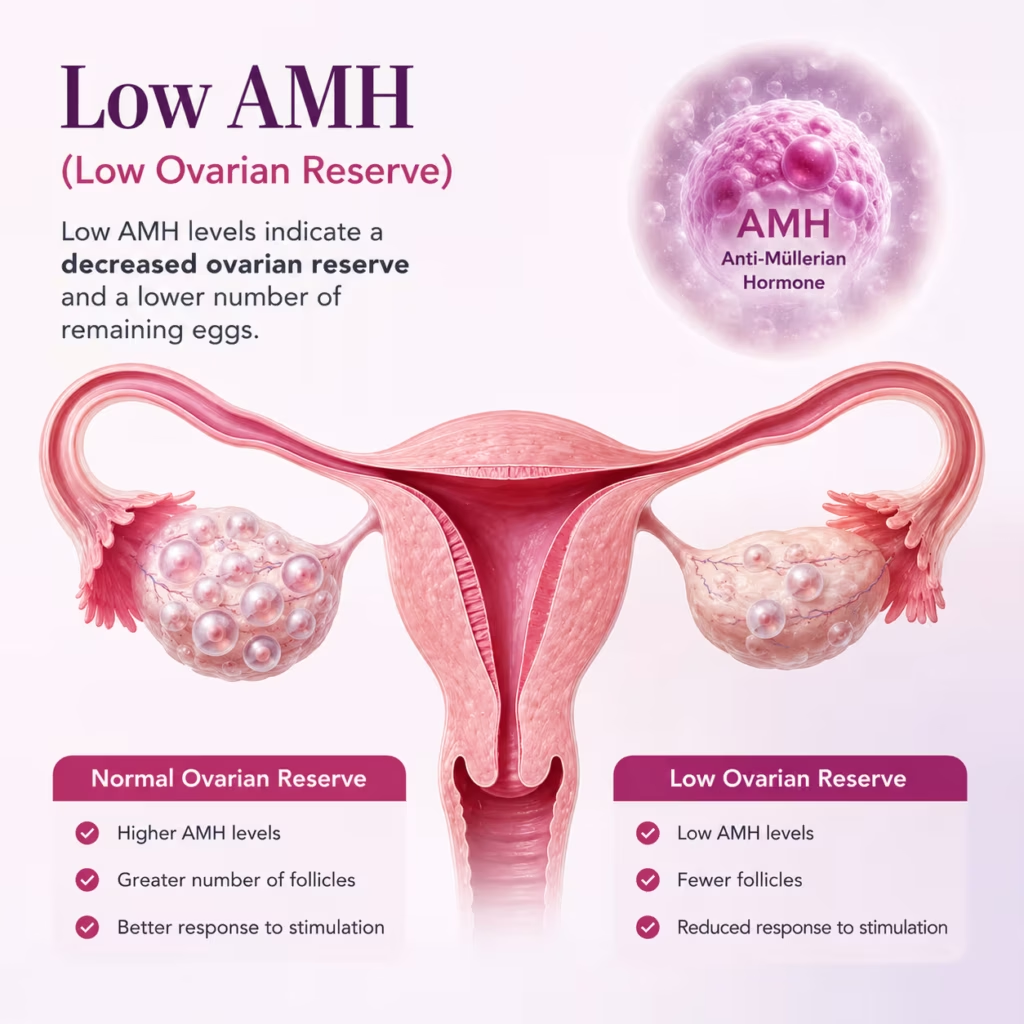
- Are you feeling worried about low AMH and IVF? You are not alone. Many women have to face the same…June 11, 2026
- Can You Increase AMH Levels Naturally? What Science Says About Low AMH and Fertility Quick Answer In most cases, AMH…June 11, 2026